The BIM maturity diagnostic: where to start when you've never assessed your firm
22 September 2026 · 7 min read
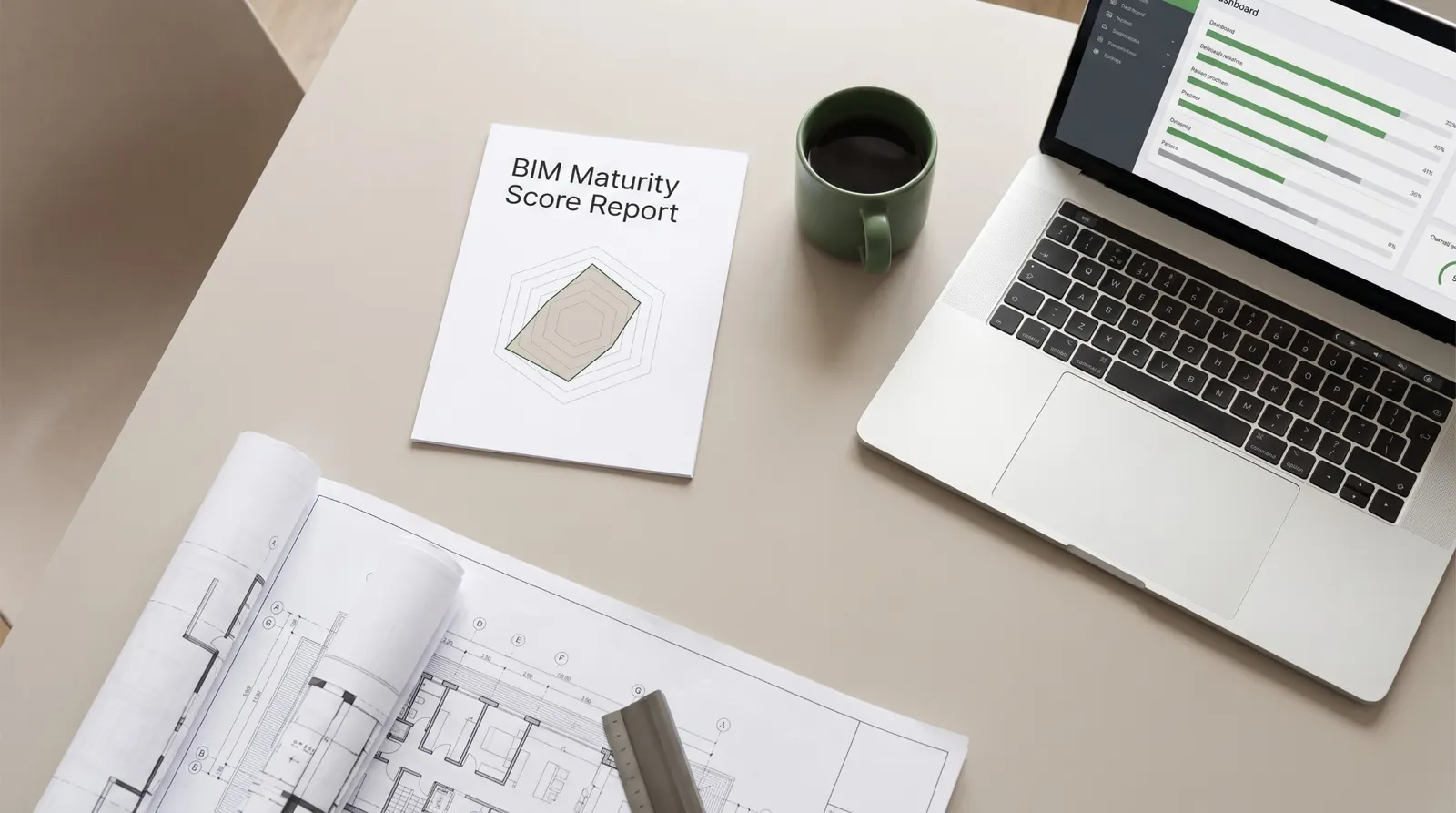
Most architecture firms have never formally assessed their own BIM maturity. That is not a lack of seriousness: a diagnostic looks, from a distance, like a long, intrusive exercise with no immediate benefit. In practice, it is the opposite. A well-framed first diagnostic takes a few hours spread over one or two weeks, and turns a vague intuition (“we’re behind on BIM”) into a precise list of what is really holding things back — and therefore what to fix first.
Why most firms shy away from the first audit
Three obstacles come up almost every time. The first is fear of the verdict: nobody wants a number to confirm that the firm is “bad” at BIM. The second is uncertainty about what is actually measured — many partners picture a technical audit of the models, when a maturity diagnostic in fact covers processes (governance, naming, information security, training), not the quality of a particular Revit model. The third obstacle, the most concrete, is time: who is going to fill in this questionnaire, and what data will they rely on if no written protocol exists?
This last point is actually good news in disguise. A maturity diagnostic does not require that practices already exist in documented form — it requires an honest answer to the question “do we do this, and how?”, even if the answer is “not really” or “it depends on the project manager”. A firm with no formalised protocol at all can easily get through its first diagnostic in forty-five minutes; that is often the fastest case, for lack of nuances to weigh.
What a maturity diagnostic really measures
It helps to separate two things that often get confused. Assessing a person means measuring an individual skill — can a modeller manage worksets, can a coordinator detect clashes. Assessing a firm’s maturity is something else entirely: it looks at whether the firm, as an organisation, has put in place shared rules of the game that do not depend on a single person. A firm can have excellent individual modellers and still be immature, if everyone works with their own conventions, with no shared naming convention or structured common data environment.
This is why the ISO 19650 framework breaks maturity down into process themes — common data environment, information requirements, roles and responsibilities, coordination, information security, training, governance — rather than software skills. A serious diagnostic asks questions like “is a structured common data environment used on projects?” or “are workflow statuses (work in progress, shared, published, archived) applied consistently?”, on a four-level scale from non-existent to mastered. Nobody is judged individually; it is the organisation that is photographed.
Who to involve, and why not just the BIM Manager
The natural instinct is to hand the questionnaire to the firm’s one BIM person — BIM Manager, coordinator, or simply the employee most comfortable with Revit. That is a common mistake, for a simple reason: that person sees the practices from the point of view of whoever put them in place, not from the point of view of whoever has to follow them day to day on a project under deadline pressure. A project manager or an associate architect may have a very different view of what is actually respected on the ground, as opposed to what is written in a protocol that nobody consults any more.
In a small firm, the diagnostic can stay in the hands of a single person, provided they cross-check their impressions against two or three recent project examples rather than answering from memory. In a larger firm, it is better for a partner or a technical director to validate the answers before treating them as final — not to soften them, but to avoid a score that looks good on paper and is contradicted in practice on the very next project.
How to read the score without mistaking it for a school grade
A maturity score of 40 or 50 out of 100 is not a failure — it is the starting point for the large majority of firms doing their first diagnostic. The number itself matters less than its breakdown by theme: a firm can show an average overall score while already being very solid on information security, and well behind on document management. It is this unevenness, invisible in a single score, that should guide priorities.
- A low score does not mean the firm produces poor-quality work — it means quality still depends too much on individuals, not on shared processes
- A high score on one theme and a low score on another is more useful than an average score everywhere: it shows where to focus effort first
- Comparing your score to an industry average has little value the first time — what matters is comparing it to your own score at the next diagnostic
- A score is not anyone’s individual responsibility: it describes an organisation at a given moment, not an individual’s skills
Turning the result into an action plan rather than a report that gathers dust
The most common risk after a diagnostic is not misreading it — it is doing nothing with it. A twenty-page report with an overall score and a theme-by-theme breakdown too often gets shared once in a partners’ meeting, then forgotten until the next diagnostic, if there is one. What makes the difference is coming out of the diagnostic with two or three concrete actions, dated, and assigned to a person responsible for carrying them out — not ten parallel workstreams that no mid-sized firm has the capacity to run at once.
- Pick the two weakest themes that are not already covered by an ongoing effort, rather than trying to fix everything at once
- Set a realistic deadline (three to six months) for each action, with a simple, checkable deliverable — a template created, a convention documented, access rights revised
- Name a single person responsible for each action, even if several people contribute: a workstream with no clear owner does not move forward
- Share the action plan with the whole team, not just the partners — the people who will apply the new rules need to understand why

How often to repeat it
An annual diagnostic is a good default pace for most firms: spaced out enough to let corrective actions produce a visible effect, frequent enough not to lose the thread of progress. A firm going through a faster phase of change — significant hiring, a change of production tool, first projects under contractual ISO 19650 requirements — may want to tighten this to six months, long enough to stabilise its new practices. What matters is not the frequency itself, but consistency: a single diagnostic gives a snapshot; a series of diagnostics gives a trajectory, and it is the trajectory that really matters to a firm’s leadership.
A single diagnostic gives a snapshot; a series of diagnostics gives a trajectory, and it's the trajectory that really matters to a firm's leadership.
BIMaturity's BIM maturity diagnostic is done online, question by question, with no unnecessary jargon: a free overall score, with a theme-by-theme breakdown and a prioritised action plan in the full report.
Assess my firm's maturity →Frequently asked questions
How long does a first BIM maturity diagnostic take?
A few hours spread over one to two weeks. A firm with no formalised protocol at all can even get through it in forty-five minutes, for lack of nuances to weigh.
Do practices need to already be documented to answer the questionnaire?
No. It is enough to answer honestly the question “do we do this, and how?”, even if the answer is “not really” or “it depends on the project manager”.
Should only the BIM Manager answer the diagnostic?
No, that is a common mistake: a project manager or a partner often sees the practices actually followed on the ground very differently from the person who put them in place.
Is a score of 40 or 50 out of 100 a bad result?
No, it is the starting point for the large majority of firms doing their first diagnostic. What matters is the breakdown by theme, not the overall number.
How often should the diagnostic be repeated?
An annual pace suits most firms; those going through faster change (significant hiring, new tools, first contractual ISO 19650 projects) can tighten this to six months.